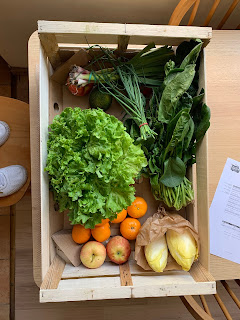
Big sun in the sky, a side of smoked salmon in the fridge, listening to Jack Johnson, 12 creme eggs (make that 11, no 10), a sparkly turquoise necklace, happy smiley students, cheque in the post, Kenzo perfume, a pile of new books, children being children, me being a muse, birthday cards on the shelf, Easter holidays on the horizon, an early night.
With apologies to Ian Dury and there was just no way I could make it rhyme.
Tuesday, March 14, 2006


Wednesday, March 08, 2006
Playing Doctors and Nurses
I think I first read the following riddle, which still seems to be doing the rounds, in the 1970s in the Reader's Digest :
I'm frankly dismayed by the number of women students of medicine who still automatically and consistently employ the personal pronoun "he" when referring to a doctor and the strange thing is that there are more young women studying medicine than men.
But perhaps it's not all that surprising really when one of the major publishers of medical textbooks is using the image on the front cover of its current catalogue:

The message is clear if stylized: doctors are intelligent men with square jaws who look down on admiring little nurses.
While we're on the subject, has anyone else been reading Dr Crippen's ongoing diatribe against specialist nurses? I don't live in the UK and I have no experience of specialist nurses and I'm more than willing to believe that the National Health Service is slowly being flushed down the toilet, and that the usurpation by specialist nurses of some of the power traditionally held by doctors is somehow part of that process. I refuse, however, to swallow his elitist guff about a group of specialist nurses:
Today, 8th March, has been declared blog against sexism day. That was my contribution.
A father and a son were in a car accident. The father went home to rest. The son was taken to the hospital for minor surgery. The surgeon came in and said: "I can't operate on this boy because he's my son." How is this possible?As children of the '60s we went through all sorts of lateral thinking solutions before we got to that one: he was adopted and the doctor was his real father; the man in the car wasn't really his father but his grandfather; his father had a twin brother; he'd been abducted by aliens. A woman surgeon was the very last thing we thought of.
Answer: The surgeon was his mother.
I'm frankly dismayed by the number of women students of medicine who still automatically and consistently employ the personal pronoun "he" when referring to a doctor and the strange thing is that there are more young women studying medicine than men.
But perhaps it's not all that surprising really when one of the major publishers of medical textbooks is using the image on the front cover of its current catalogue:

The message is clear if stylized: doctors are intelligent men with square jaws who look down on admiring little nurses.
While we're on the subject, has anyone else been reading Dr Crippen's ongoing diatribe against specialist nurses? I don't live in the UK and I have no experience of specialist nurses and I'm more than willing to believe that the National Health Service is slowly being flushed down the toilet, and that the usurpation by specialist nurses of some of the power traditionally held by doctors is somehow part of that process. I refuse, however, to swallow his elitist guff about a group of specialist nurses:
This gaggle of well-meaning women have neither the training nor the intellectual capacity to understand what is going on, and are incapable of making judgements.Despite Dr Crippen's protestations to the contrary, that to me is sexist language. What do you think?
Today, 8th March, has been declared blog against sexism day. That was my contribution.
Tuesday, March 07, 2006
Lost Forever
The Sopranos Season Six starts in the USA on March 12th. Goody, goody (or even baddy, baddy).
You may remember that episode of The Sopranos in which Tony bellows at his mother Livia telling her just what a f*****ing useless grandmother she is to his kids. The reason ? He’s just come across an album that she was supposed to fill up with photos and memories for the children and the pages are all still blank. Carmela’s parents have filled theirs up, why couldn’t she ?
I sympathise with poor old Livia.
My children both have hopelessly empty baby albums on their bookshelves. Date first tooth appeared: empty. Photos of first birthday party: blank. Family tree to fill in : zilch. First words spoken : gaping void.
I do have their first ultrasound pictures and their hospital bracelets somewhere (where?) and I did keep a lock of their baby hair — although I can’t for the life of me work out which is which.
I do feel a little guilty about this failure on my part. I mean, I actually bought the albums myself, imagining the fun I would have filling them in, cutting out photos, sticking in little scraps of ribbon and wool that would trigger tender memories years later. Writing down each new bon mot. Somehow, in the whirlwind of the baby years, I just never got round to it.
I don’t have a baby album of my own but my Mum did keep every single birthday card I received until I was twelvish. Some babyhoods, of course, are hyper-documented and I feel even more inadequate when I read Dooce’s latest monthly letter to her daughter. She writes :
Sometimes I go back and read the things I wrote to you in the early months and I realize that I’ve already forgotten half of what happened, and if it weren’t for what I’ve written here I could have lost certain memories forever.I just hope the children don’t decide on the mafia as a career path when they grow up. Otherwise I may end up as fish food . Maybe I should just burn the empty baby-album evidence now, or maybe I could just make it all up. Do you think they’d mind?
Tuesday, February 28, 2006
It's a funny old B'sphere
I always used to think that Dooce was a bit of a blogsnob because there was no comments box on her site. Now I know why. Talk about opening the floodgates: she's had over a 1200 comments in about 24 hours and the number still seems to be climbing. It would take a full working day to read all of them but from a cursory glance, I'd say that they're pretty good quality comments too. There's none of that sycophantic "I love your blog. You're so funny" stuff you see on some other famous blogs. Although the whole concept of famous and A-list is obviously relative: I doubt anyone is playing in the same league as Dooce. And she IS funny and I do looooove her blog (but not the photos of the dog, and not really the photos of the small person if I'm honest). Obviously readers want to interact with their blogheros, but on that sort of scale, it's not a conversation it can't be anything other than an enormous, unmanageable, sequential cacophony however civilised and reflective.
I suspect that a lot of people, like Dooce, would like to live entirely off blogging (I'd quite like to make a living entirely from reading blogs, the hours are better). Jason Kottke tried it for a year but is giving up, citing lack of traffic, and inability to build a "cult of personality". Do, I detect a little pique in his post on the subject? Any tension there should make for good small talk in his opening "conversation" with Heather Armstrong at the big Blog thing in Austin, Texas. My advice Jason? Get yourself a baby, buy a dog.
If I was contemplating a writing life based on cult of personality I think I'd go for a newspaper career — same reader expectations, same deadlines, but you don't have to pose for the camera.
And finally, you can blame Boing Boing for this. I'm not 100% sure what smartfilter is but just had to have the picture.

Ooops, apologies, I've just gone back and corrected six typos in that post. Note to self: don't write posts in bed anymore.
Thank God, a meme
Can't think of anything worth writing about unless you'd like to hear about departmental (emphasis on the mental) politics, a very bad Indian meal, or mesotherapy. So I'm grabbing this meme encountered at Badbadbadger's and I'm running with it. You can all fall out now.
I had to change the original instructions because I still can't do scoring out with Mac and Blogger. So here's my own system:
The Catcher in the Rye - J.D. Salinger* (read it when I was 12. Favourite line at the time: "He was about as sensitive as a goddam toilet seat".)
The Hitchhiker's Guide To The Galaxy - Douglas Adams*
The Great Gatsby - F.Scott Fitzgerald*
To Kill a Mockingbird - Harper Lee*
The Time Traveler's Wife - Audrey Niffenegger
(His Dark Materials - Philip Pullman)
Harry Potter and the Half-Blood Prince - J. K. Rowling (Read the first H.P., do not feel impelled to read the others. Will my children want this one read to them?)
Life of Pi - Yann Martel (Borrowed it from the library and never got round to reading it)
Animal Farm: A Fairy Story - George Orwell* (Read it a school)
Catch-22 - Joseph Heller* (Does anyone still read this?)
The Hobbit - J. R. R. Tolkien (What was i reading when everyone else was reading this?)
The Curious Incident of the Dog in the Night-time - Mark Haddon (Loved it)
Lord of the Flies - William Golding (another "required reading" school book)
Pride and Prejudice - Jane Austen (did I really read this or do I just think I read it?)
1984 - George Orwell
Harry Potter and the Prisoner of Azkaban - J. K. Rowling
One Hundred Years of Solitude - Gabriel Garcia Marquez (was given this as a present when it first came out. Didn't finish it for another five or six years)
Memoirs of a Geisha - Arthur Golden
(The Kite Runner - Khaled Hosseini) Never heard of it, but I like the title
The Lovely Bones - Alice Sebold (I felt that there was something dishonest at the heart of this book. In my experience, dead people are dead.)
Slaughterhouse 5 - Kurt Vonnegut
Angels and Demons - Dan Brown (puleeze)
Fight Club - Chuck Palahniuk
(Neuromancer - William Gibson)
(Cryptonomicon - Neal Stephenson)
The Secret History - Donna Tartt
A Clockwork Orange - Anthony Burgess
Wuthering Heights - Emily Bronte
Brave New World - Aldous Huxley*
The Lion, the Witch and the Wardrobe - C. S. Lewis (missed out on this. I think my primary school teacher was reading us Biggles when everyone else was in this fantasy world.)
Middlesex - Jeffrey Eugenides (Borrowed this one from the library too and didn't read it. There's a librarian with very good taste in English books at our local library or médiathèque as they like to call it.)
(Cloud Atlas - David Mitchell)
The Lord of the Rings - J. R. R. Tolkien
Jane Eyre - Charlotte Bronte
(Good Omens - Terry Pratchett, Neil Gaiman)
Atonement - Ian McEwan *(Liked this one except for the ending. Loved "Saturday")
(The Shadow Of The Wind - Carlos Ruiz Zafon)
The Old Man and the Sea - Ernest Hemingway
The Handmaid's Tale - Margaret Atwood (started, couldn't finish)
The Bell Jar - Sylvia Plath (Picked this one up in the library last Tuesday and wondered if perhaps I shouldn't borrow it. Maybe I will)
Dune - Frank Herbert (Sat through this at the cinema. Despite Sting's good looks, that was quite enough)
Who chose these book titles and why I wonder? It's a strange mixture.
I had to change the original instructions because I still can't do scoring out with Mac and Blogger. So here's my own system:
- green for the ones I've read,
- an asterix if I have them on my bookshelf (or in a box in the loft),
- red for the ones I won't read,
- italics for the ones I might read and
- brackets around those I've never heard of.
The Catcher in the Rye - J.D. Salinger* (read it when I was 12. Favourite line at the time: "He was about as sensitive as a goddam toilet seat".)
The Hitchhiker's Guide To The Galaxy - Douglas Adams*
The Great Gatsby - F.Scott Fitzgerald*
To Kill a Mockingbird - Harper Lee*
The Time Traveler's Wife - Audrey Niffenegger
(His Dark Materials - Philip Pullman)
Harry Potter and the Half-Blood Prince - J. K. Rowling (Read the first H.P., do not feel impelled to read the others. Will my children want this one read to them?)
Life of Pi - Yann Martel (Borrowed it from the library and never got round to reading it)
Animal Farm: A Fairy Story - George Orwell* (Read it a school)
Catch-22 - Joseph Heller* (Does anyone still read this?)
The Hobbit - J. R. R. Tolkien (What was i reading when everyone else was reading this?)
The Curious Incident of the Dog in the Night-time - Mark Haddon (Loved it)
Lord of the Flies - William Golding (another "required reading" school book)
Pride and Prejudice - Jane Austen (did I really read this or do I just think I read it?)
1984 - George Orwell
Harry Potter and the Prisoner of Azkaban - J. K. Rowling
One Hundred Years of Solitude - Gabriel Garcia Marquez (was given this as a present when it first came out. Didn't finish it for another five or six years)
Memoirs of a Geisha - Arthur Golden
(The Kite Runner - Khaled Hosseini) Never heard of it, but I like the title
The Lovely Bones - Alice Sebold (I felt that there was something dishonest at the heart of this book. In my experience, dead people are dead.)
Slaughterhouse 5 - Kurt Vonnegut
Angels and Demons - Dan Brown (puleeze)
Fight Club - Chuck Palahniuk
(Neuromancer - William Gibson)
(Cryptonomicon - Neal Stephenson)
The Secret History - Donna Tartt
A Clockwork Orange - Anthony Burgess
Wuthering Heights - Emily Bronte
Brave New World - Aldous Huxley*
The Lion, the Witch and the Wardrobe - C. S. Lewis (missed out on this. I think my primary school teacher was reading us Biggles when everyone else was in this fantasy world.)
Middlesex - Jeffrey Eugenides (Borrowed this one from the library too and didn't read it. There's a librarian with very good taste in English books at our local library or médiathèque as they like to call it.)
(Cloud Atlas - David Mitchell)
The Lord of the Rings - J. R. R. Tolkien
Jane Eyre - Charlotte Bronte
(Good Omens - Terry Pratchett, Neil Gaiman)
Atonement - Ian McEwan *(Liked this one except for the ending. Loved "Saturday")
(The Shadow Of The Wind - Carlos Ruiz Zafon)
The Old Man and the Sea - Ernest Hemingway
The Handmaid's Tale - Margaret Atwood (started, couldn't finish)
The Bell Jar - Sylvia Plath (Picked this one up in the library last Tuesday and wondered if perhaps I shouldn't borrow it. Maybe I will)
Dune - Frank Herbert (Sat through this at the cinema. Despite Sting's good looks, that was quite enough)
Who chose these book titles and why I wonder? It's a strange mixture.
Friday, February 24, 2006
What big feet you have!
Here are my brand new beautiful brown suede cowboy boots. Whadyathink? And more importantly, how much do you think I paid for them?
It's a pity you can't stroke their chocolatey, soft loveliness.
(I cannot believe I've just spent twenty minutes taking those photos and making them into a photo cloud. I have work to do! Lots of work to do! I must legitimise this waste of time with some sort of pseudo-pedagogical application.)
It's a pity you can't stroke their chocolatey, soft loveliness.
(I cannot believe I've just spent twenty minutes taking those photos and making them into a photo cloud. I have work to do! Lots of work to do! I must legitimise this waste of time with some sort of pseudo-pedagogical application.)
Thursday, February 23, 2006
Ingrid Betancourt

I don't think there is any woman I admire more than Ingrid Betancourt who has now been a hostage for 4 years.
Monday, February 20, 2006
A Week in the Basque Country

Just back from another trip to the Basque Country during our half-term break. We stayed in a big old farm house with lots an lots of friends. Apart from us and the florist and the landscape gardener and the neo-hoteliers and the dentist and the doctor and the teacher and the unionist and the school administrator, and the soon-to-be B&B landlady, the house was overun by a gaggle of excited children. During the day we hiked over hill and dale. Lunch was serrano ham and sheep's cheese. In the evening, magret was grilled in the massive hearth and much wine and hilarity flowed at a very long table.
For some reason most of my photographs seem to be of windows.
Saturday, February 11, 2006

Friday, February 10, 2006
Talking the talk
I seem to remember seeing a TEFL-type job description somewhere — it may have been for lettori in Italy — that specified that all candidates must be fresh meat. Okay, that wasn't the actual expression that they used, it may have been something more like "linguistically and culturally fresh off the boat". Okay, it wasn't exactly that either, but you know what I mean, they didn't want anyone who'd been living abroad for any length of time and had gone more or less native. And I also seem to remember sucking air in through my teeth in exasperation. Poor people, did they really think that one could forget a language that quickly; become cut off from one's native culture that easily?
Well, no of course you can't, but you can very rapidly feel yourself slipping out of the loop of knowing what people at home are actually talking about (who is this Davina McCall?) and knowing what terms are actually acceptable. After all, when I first moved to France it was still perfectly all right to say someone was handicapped and coloured.
Even more importantly how can I tell which terms are cool.... or should that be hip? When my brother and I were teenagers, I remember my Mum asking us things like "So, is he going with her?" and we would dissolve in disdainful laughter. What a fool she was; didn't she know that you could only say "Is he going OUT with her"? For goodness sakes, wise up woman, we're in the late seventies, don't you know?
Well, I am that woman now. I'm middle-aged and I have the added disadvantage of living in a non-English -speaking country. I think I managed for a while to keep up but got stuck at the "I am so enjoying this..........not" stage which I no doubt picked up from a rerun of Friends.
There's only one consolation: my children probably won't know any better, just so long as I deprive them of any authentic English-language interaction with young native-speakers for the next ten years.
Monday, February 06, 2006
coComment
I seem to remember saying a while ago how great it would be if there was some way of centralising, collating and monitoring follow-up to the comments I had left littered across the blogosphere. coComment looks as if it might be that tool. It's an invitation-only beta at the moment but I ended up with two invites so if you'd like one, leave a comment.
(via pointblog.com)
UPDATE: It's gone
(via pointblog.com)
UPDATE: It's gone
Sunday, February 05, 2006
Other things that went well this weekend
Via Lifehacker found an application called Senuti that copied all the music on my iPod onto my PowerBook. Something I'd been trying to do for ages.
Bought a wifi stick on Ebay which should (fingers crossed, fingers crossed) mean that the family Imac gets internet again without us forking out for an airport card.
Discovered that an older cousin who likes to play at being the teacher can keep young children amused for almost an entire weekend.
Got 7/10 playing this word game.
Made Wendy's Linguine and Leeks. Delicious.
Sold the crappiest Michel Sardou CD in the history of French musak and made enough euros to buy a bottle of Tariquet. Fair exchange.
Here we go, here we go, here we go...

Scotland 20 - France
I have suffered through countless painful France-Scotland matches in the past nine years, ever the good loser. Needless to say, I was out this afternoon and missed our moment of glory. Allez L'Ecosse!
Thursday, February 02, 2006
The first hour
I’ve asked my class of student bloggers to post about a typical day in their lives and in a spirit of egalitarianism, I had intended to make my own contribution but it turned out to be excruciatingly boring. I’m going to inflict the first hour on you anyway.
The alarm invariably goes off at 7H10 and I invariably ignore it. I get up half an hour later and rush around making coffee and hot chocolate, showering, waking the children up, dragging them out of bed and into hastily selected clothes. I never know what to eat in the morning so I often leave the house with only a couple of cups of black coffee swilling around inside me. I stuff my PowerBook into my workbag.
We walk to nursery school. On a good day the children skip; on a bad day they demand to be carried, sometimes both of them at the same time. Today, Z told me he had had enough of working. I accompany them to their makeshift classrooms; the school is undergoing a prolonged facelift. Some of the other parents say “bonjour”, some don’t bother. I cheek kiss the few I know a bit better. The children slip into their daytime identities.
Then it’s off to the tram stop, unravelling my grubby i-Pod headphones as I go. I usually have time to listen to three or four tracks on the way in. Today, I only got one — an interminable Led Zep number. And this is where I get off.

Monday, January 30, 2006
Oane, tou, sri, for

I give up. Pronunciation is notoriously difficult to teach (and learn) and I spend a lot of my working life correcting the usual "z"s for "th"s and "ee"s for "i"s. Some learners are so convinced that you don't need to pronounce the "h" at the beginning of a word that they don't even bother to write it, so I get this sort of thing to in essays "I ear the bells". On the other hand, they are often tempted to slip an "h" in before a vowel at the beginning of a word, as in "I hate my dinner". It's an uphill struggle and made all the more difficult by the fact that most of the students I come into contact with have been studying English for more than eight years and the mistakes are fossilised. It's really important to be exposed to correct pronunciation models from the very beginning.
It looks as if things are not going to be getting any better. Yesterday, while reading to E., I discovered this handy pronunciation guide in which the blessed Dora the Explorer (she speaks heavily accented English in the French version) recommends that the little people say él-lo for hello, sri for three, and for for four. No, no, no, no no, no, no. Dora is a dunce.
Saturday, January 28, 2006
Words

Look! A cloud of commonly used words from this blog. I could even have it made into a t-shirt. Get your own from snapshirts.
Poetry
I'm not a great reader of poetry. I did the usual stuff at school of course: a couple of pieces from A Child's Garden of Verses in primary school, some of the early Scottish ballads, that Tennyson about the eagle and the azure sky, "Timothy Whatshisname goes to school", a bit of Burns, some unfathomable T.S. Eliot,and and even some Verlaine in secondary school. I also attended and enjoyed readings by Roger McGough, Edwin Muir, and Norman McCaig. I remember buying an anthology of poetry for my French course at university but I can only dredge up a fragment of a single line from one poem by Paul Eluard: "debout sur mes paupières". If forced, I could probably still recite a bit of Burns, but that's about as far as it goes and I could certainly tell you more about the lives of Rimbaud and Verlaine than I could about their writing.
Although I own several books by poets, I tend to settle for their prose writing rather than their poetry. For example, although I find the deceptively smooth poetry of Hugo Williams seductive ("If it doesn't look easy you're not trying hard enough"), I far prefer his similarly suave column in the TLS and bought a collection of that prose writing a few years ago. I have also devoured and regularly reread Kenneth White's travel writing, but his poetry books, some of which I do have, just don't exert the same attraction. I have some incredibly poetic books by Kathleen Jamie and Alistair Reid too, but none of their poetry. The Collected Letters of Larkin sit on my bookshelf and have been read in their (occasionally tedious) entirety, but I don't have any of his poems.
I used to think that poetry held so little attraction for me because of my lack of musicality. Or perhaps I just didn't have enough soul. But, a passage from Ian McEwan's most recent novel, Saturday, suggests a better explanation. The protagonist finds that "even a first line can produce a tightness behind his eyes:
"Novels and movies, being restlessly modern, propel you forwards or backwards through time, through days, years or even generations. But to do its noticing and judging, poetry balances itself on the pinprick of the moment. Slowing down, stopping yourself completely , to read and understand a poem is like trying to acquire an old-fashioned skill like dry stone walling or trout tickling."The truth is, then, that reading poetry is a skill that simply takes more time and effort than reading most prose. It's not something you can do properly lying in bed, and subscribing to a poetry blog is no magic bullet either, since the very nature of blog-reading means that one scans them quickly for instant reading gratification. Perhaps poetry podcasts are the answer — there is something very attractive in the idea of effortlessly assimilating the words of a poem whispered directly into my ear from my pink i-Pod as the tram whisks me into work. If it's not in bed and it's not in the tram, the alternative for me is reading poetry in the living-room with the repetitive cadences of Dora in the background: Chipeur arrête de chiper, Chipeur arrête de chiper, Chipeur arrête de chiper..
Friday, January 27, 2006


Monday, January 23, 2006
Statistically insignificant
In a recent comment about the increasing difficulty of standing out from the crowd, R. Brett Stirling recalls Milan Kundera writing that
The chances are that you will have eight great-children. Of those eight great-grandchildren only two will remember your name. I learned this in an excerpt from The Human Body that I use with students of medicine. They don't find it as depressing as I do. (We learned from the same excerpt that I can except to shed 19 kilos of dead skin during my lifetime. Now that gets a reaction)
And here, for balance, is another statistic confirming, this time, the inevitable heaviness of our (or at least my) being. In a chapter from Atul Gawande's book Complications that I had chosen to study in class today, I stopped at the following piece of information: a review of decades of diet studies
"in Socrates day he was maybe 1/250,000th of the population, Lincoln: 1/1,000,000,000th. Each of us? 1/6,200,000,000th."So here are some more sad statistics that have jumped out at me recently reflecting the unbearable lightness of our being.
The chances are that you will have eight great-children. Of those eight great-grandchildren only two will remember your name. I learned this in an excerpt from The Human Body that I use with students of medicine. They don't find it as depressing as I do. (We learned from the same excerpt that I can except to shed 19 kilos of dead skin during my lifetime. Now that gets a reaction)
And here, for balance, is another statistic confirming, this time, the inevitable heaviness of our (or at least my) being. In a chapter from Atul Gawande's book Complications that I had chosen to study in class today, I stopped at the following piece of information: a review of decades of diet studies
"found that between 90 and 95% of people regained one-third to two-thirds of the weight they'd lost within a year — and all of it within five years."Again, my class of skinny 19-year-olds weren't as disheartened by that information as I was.
Sunday, January 22, 2006
Gastroenteritis
I will spare you the "Streaming Puke Stream of Consciousness" post. Must get back to the washing.
Subscribe to:
Posts (Atom)
Confinement
Being confined indoors most of the day, just the four of us, is reminding me of the days when my children were wee and most of our weekends ...